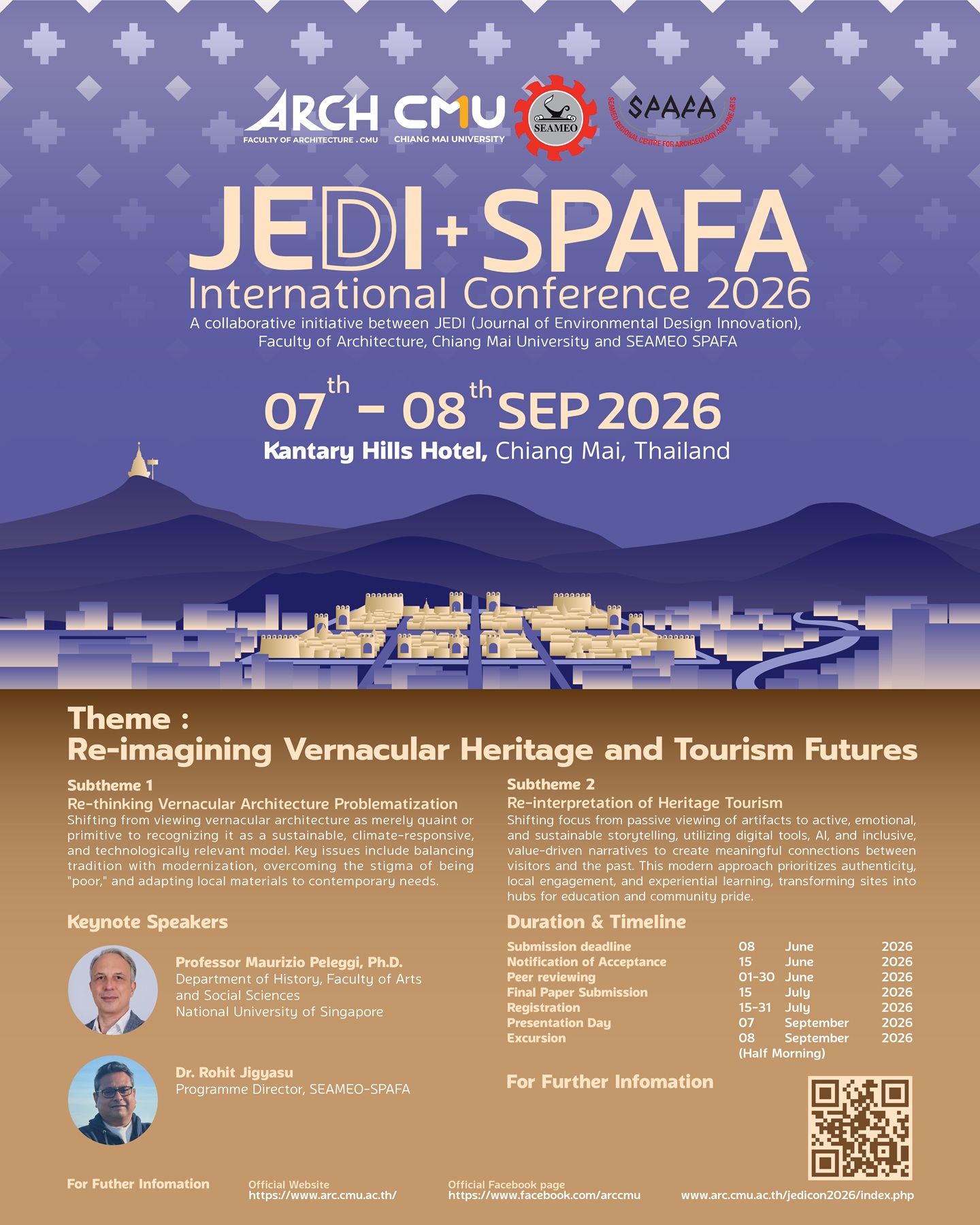
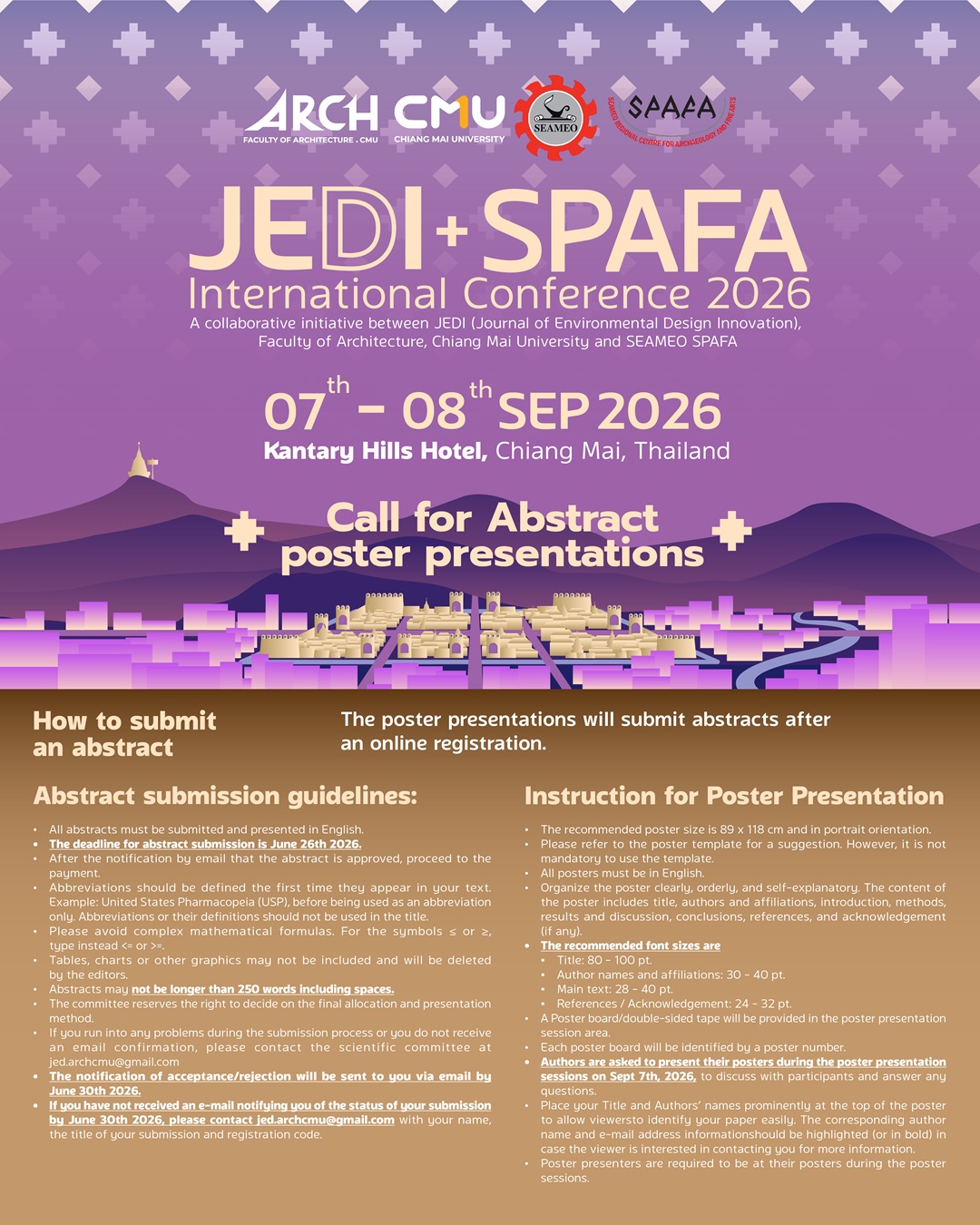
Re-imagining Vernacular Heritage and Tourism Futures

International Academic Conference 2026
JEDICON 2026 + SPAFA Journal
Journal of Built Environment Innovation Conference
Conference Date
7–8 September 2026
Venue
Kantary Hills Hotel, Chiang Mai, Thailand
Submission Deadline
30 April 2026
SCROLL

Key Dates

Deadline
Submission Deadline
30 April 2026
Notification
Notification of Acceptance
30 May 2026
Review
Peer Reviewing
1–30 June 2026
Final
Final Paper Submission
15 July 2026
Registration
Registration
15–31 July 2026
Conference
Conference Date
7–8 September 2026
Submission Deadline
30 April 2026
Notification of Acceptance
30 May 2026
Peer Reviewing
1–30 June 2026
Final Paper Submission
15 July 2026
Registration
15–31 July 2026
Conference Date
7–8 September 2026
JEDICON 2026 Poster

Submission Process

Six steps from paper submission to publication in the conference proceedings

01
STEP 01
Register

Submit your name, email, and affiliation. You will receive a magic link via email to access the submission system — no password required.

02
STEP 02
Submit Paper

Upload your full paper (PDF/DOCX) and fill in the paper details. No payment required at this stage.

03
STEP 03
Peer Review

Your submission is evaluated by 3 independent reviewers through a double-blind peer review process.

04
STEP 04
Decision & Revision

You will be notified by email: Accept / Revisions Required (resubmit) / Reject.

05
STEP 05
Payment

Once your paper is accepted, pay the registration fee and upload your payment slip. Admin verifies within 3–5 business days.

06
STEP 06
Final Paper & Publication

After payment is confirmed, upload your final paper. Accepted papers will be published in the JEDI & SPAFA Journal.

0
Submitted
0
Reviewed
Blind
Review

Re-imagining Vernacular Heritage and Tourism

JEDICON 2026 + SPAFA Journal

Re-imagining vernacular heritage and tourism involves shifting from passive sightseeing to immersive, co-created experiences that honor living culture, local craftsmanship, and sustainable practices. By adapting, rather than just preserving, traditional architecture and intangible heritage, destinations can foster authentic visitor engagement while supporting local communities. This approach transforms heritage villages into living landscapes where local knowledge systems shape tourism, combating commodification.

Key Aspects

Living Cultural Landscapes
Viewing heritage as active, everyday life (e.g. rituals, crafts, local food) rather than static monuments.
Adaptive Reuse & Sustainability
Using traditional, eco-friendly techniques for tourist accommodation, reducing environmental footprints.
Co-Creation of Experience
Engaging tourists in participatory activities such as workshops with local artisans for deeper connection.
Resisting Commodification
Ensuring tourism development does not alter the core identity of local practices to fit tourist expectations.
Post-COVID Regeneration
Leveraging local resources to build resilient, community-centered tourism strategies focused on authentic storytelling.
Intangible Heritage Integration
Highlighting local narratives and social practices to provide context for physical structures.
Community-Led Management
Empowering locals to manage tourism, ensuring economic benefits remain within the community.
Innovative Storytelling
Moving beyond superficial displays to educate visitors on the spiritual essence and historical context of the site.

Subthemes

Subtheme 1

Re-thinking Vernacular Architecture Problematization

Shifting from viewing vernacular architecture as merely quaint or primitive to recognizing it as a sustainable, climate-responsive, and technologically relevant model. Key issues include balancing tradition with modernization, overcoming the stigma of being "poor," and adapting local materials to contemporary needs.

Key Aspects
  • Rapid Urbanization and Modernization: A loss of architectural identity, with rural populations adopting non-local materials.
  • Stigma and Perception: Vernacular architecture is frequently viewed as backward or associated with being underprivileged.
  • Resource Management: Increased demand for traditional materials can lead to over-exploitation and environmental degradation.
  • Loss of Traditional Skills: The knowledge required to build using indigenous, low-impact techniques is vanishing.
  • Circular Economy Approach: Viewing vernacular buildings as prototypes for circular, sustainable, and low-energy construction.
  • Reinterpreting Context: Focusing on local practices rather than simple replication for contemporary needs.
  • Anthropology of Technology: Integrating social dynamics with technical, climate-responsive, and material-based approaches.
Subtheme 2

Re-interpretation of Heritage Tourism

Shifting focus from passive viewing of artifacts to active, emotional, and sustainable storytelling, utilizing digital tools, AI, and inclusive, value-driven narratives to create meaningful connections between visitors and the past. This modern approach prioritizes authenticity, local engagement, and experiential learning, transforming sites into hubs for education and community pride.

Key Aspects
  • Emotional & Personalized Experiences: Shifting from knowledge-based content to affection-based storytelling that enhances cultural identity.
  • Digital & AI Integration: Using digital technology, apps, and artificial intelligence to create interactive and immersive experiences.
  • Sustainability & Conservation: Using interpretation to promote environmental awareness and support tangible and intangible heritage.
  • Inclusive Narratives: Moving beyond dominant historical narratives to include diverse, often overlooked perspectives.
  • Values-Driven Approach: Focusing on what the heritage means to the visitor today, making the site a relevant educational experience.